Key takeaways
Full parallelization is the fastest way to run E2E tests at scale.
- When every test runs at the same time in isolated environments, total runtime is limited by the longest test—not the number of tests.
Sharding is not the same as full parallelization.
- Sharding splits tests across machines, but each shard still runs its assigned tests one at a time. As the suite grows, teams must keep adding nodes or accept longer test runtime.
A slow E2E test suite burns real money.
- Running 200 tests one at a time can cost ~$440,000/year (mostly in developer wait time). The problem isn’t test speed—it’s executing the suite one test at a time instead of in full parallel.
Parallel execution only works with the right infrastructure.
- Every test needs its own isolated environment and runners that start when needed. Without that, tests compete for resources, queues form, and builds slow down.
If your end-to-end tests take hours to finish, your release cycle slows to match and your team pays for it in lost engineering time. The only sustainable way to run E2E tests faster at scale, without letting cost grow alongside your suite, is full parallelization.
What is parallel software testing?
Parallel software testing is a test execution strategy where multiple tests run at the same time across separate computing resources. Each test runs in an isolated environment with its own browser instance, network configuration, and system resources. Because tests don’t wait on each other, total execution time drops dramatically.
Full parallelization of your end-to-end (E2E) suite means faster feedback, quicker regression detection, and more frequent releases. But despite those advantages, fewer than 10% of teams run more than 50 tests in parallel, and that number is declining.
Why most teams stop at sharding
Teams want to parallelize, and many try, but most stop at sharding (partial parallelization) because it's easy to set up. Then they spend their time dealing with conflicts, flakes, and long debugging cycles.
Why skipping full parallelization gets expensive
QA Wolf built full parallelization into our test infrastructure because we've seen how much teams lose without it. Long test cycles don't just slow releases, they burn through developer hours and infrastructure costs without improving reliability. If your team relies on frequent, stable releases, full parallelization is required.
The full benefits of parallelization aren't always obvious. It's a heavy lift at first; it affects how tests are written, depends on reliable infrastructure, and the payoff isn't immediate. But skipping full parallelization costs more—often in time, complexity, and compute—than getting it right from the start. Here's what that cost looks like.
How much time does running one test at a time add to your CI/CD pipeline?
Most teams optimize everything but their E2E test execution, unaware they are at war with math.
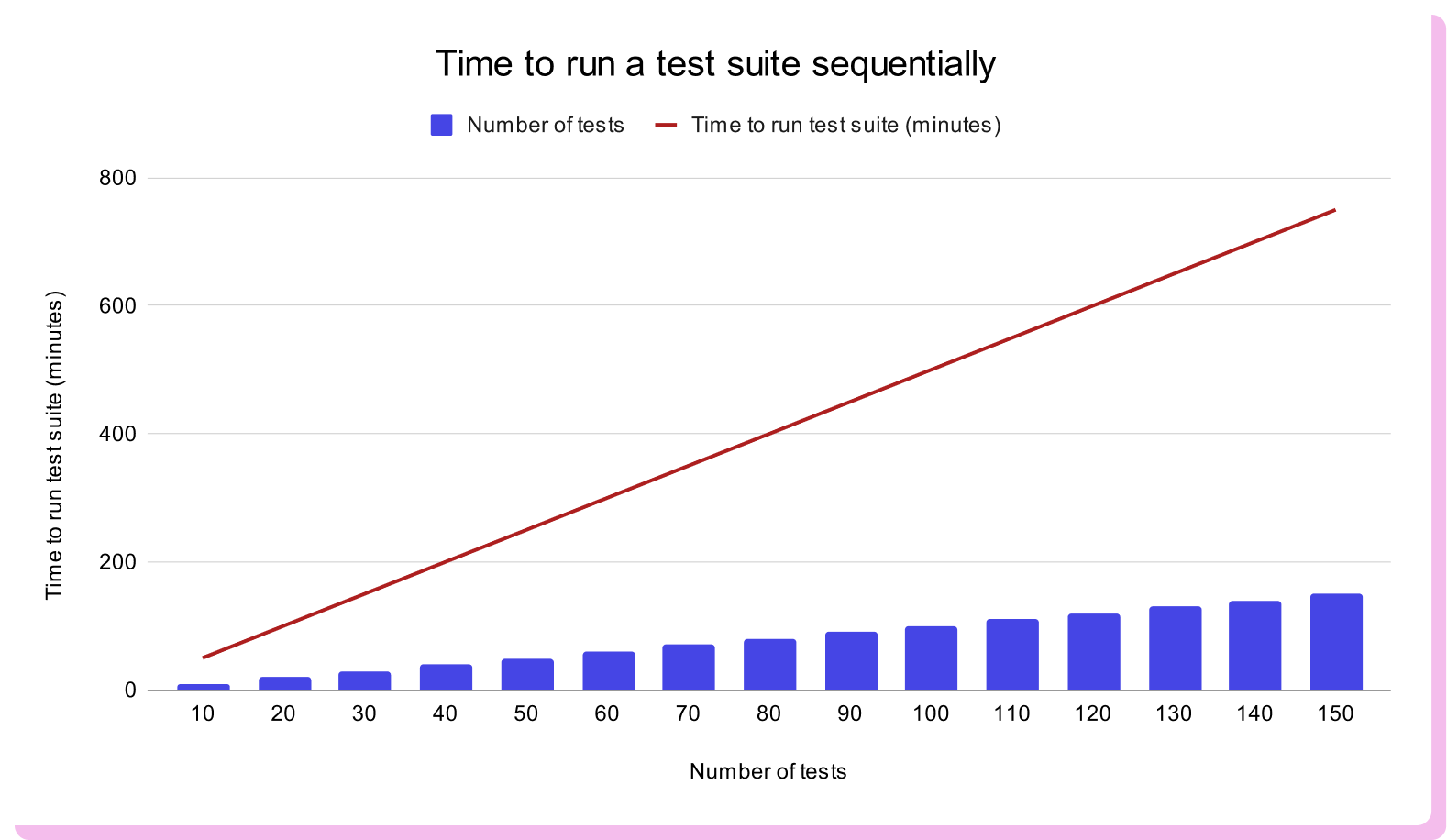
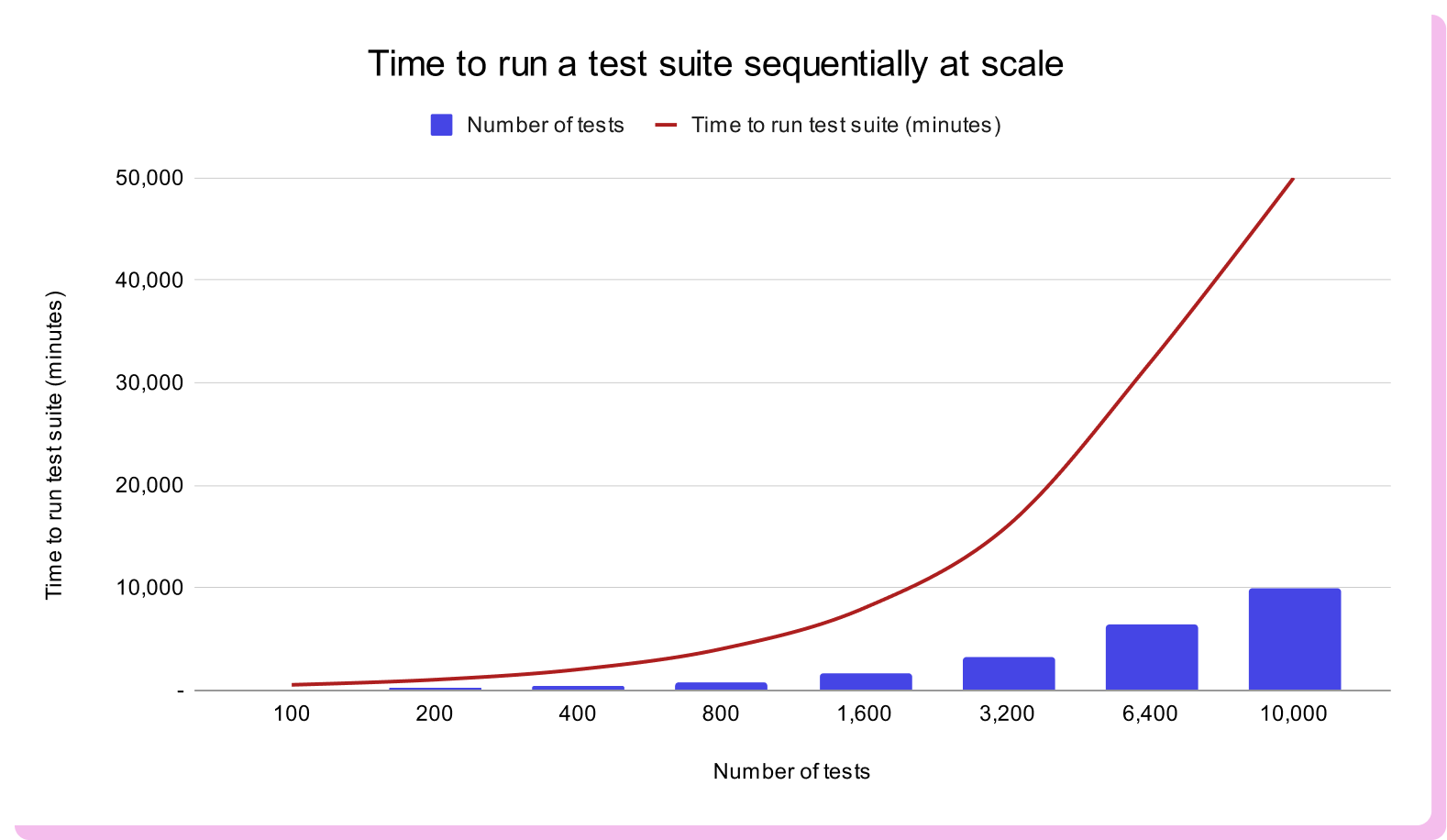
The chart above shows how quickly serialized test time grows. If one test takes five minutes, a moderately-sized suite of 200 tests takes over 16 hours.
In contrast, full parallelization holds suite time steady no matter how many tests you add. Without it, every test adds to your delivery delay.
The real cost of running tests one at a time
Our in-house calculator estimates that running 200 tests one at a time costs teams roughly $440K per year, mostly in lost dev time waiting for tests to finish.
Google found that reducing build time by just 15% led to one additional deployment per developer per week. The efficiency gains from fast feedback aren't theoretical—they show up in velocity and revenue.
Let serialized time grow, and the impact compounds: more delays, longer queues, fewer releases.
What is test sharding, and how does it compare to full parallelization?
Test sharding divides your test suite across multiple machines (shards), with each shard running its assigned tests sequentially. Full parallelization runs every test simultaneously in its own isolated environment.
Sharding is popular because it's what most cloud CI tools support by default. It's simple to set up, and for small suites, it helps. But as test volume grows, keeping build times short means adding more shards—and that gets expensive fast.
The key differences:
Scaling
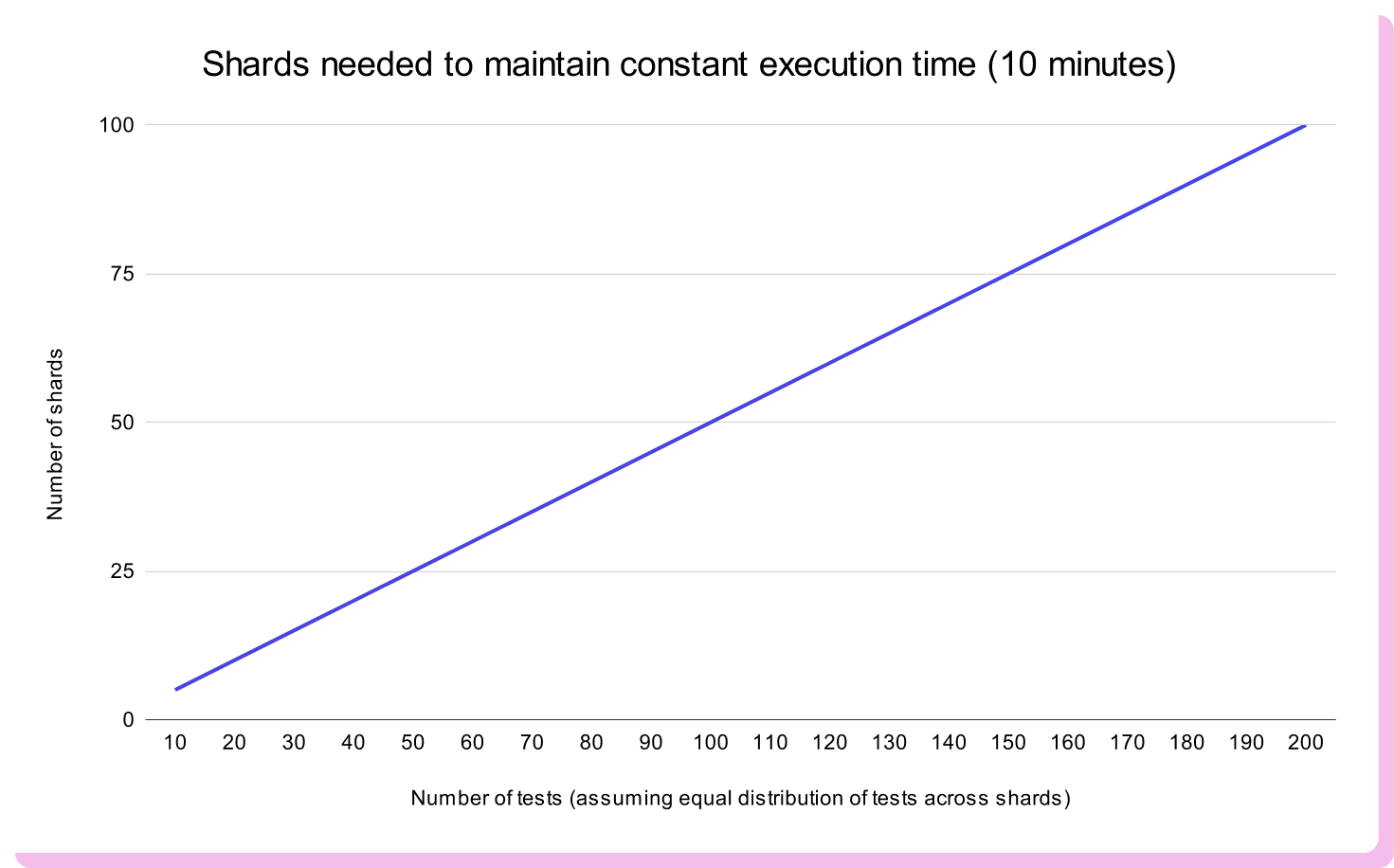
Sharding maintains execution time by adding infrastructure in direct proportion to test count. For every two tests you add, you need another node to maintain speed. Skip it, and test time grows. That means infrastructure must grow continuously as your suite expands. Full parallelization runs each test independently, so total execution time remains constant as coverage increases.
Isolation
Tests within a shard often share browser state, environment configuration, and network resources, which makes them more prone to flakes and harder to debug. E2E tests are short-lived executions that require clean, repeatable conditions: a fresh browser, stable network, and no leftovers from previous runs. Fully parallel tests run in complete isolation, reducing cross-test contamination and investigation time.
Cost efficiency
To keep a 200-test suite under 10 minutes, you need around 100 nodes. Vendors charge ~$130 per node if you’re using fewer than 25 and ~$100 as you increase. Our calculator puts that setup at roughly $55,000 annually, not including test creation or maintenance.
For every two tests you add, you need another node to maintain speed. Skip it, and test time grows. That slowdown costs $234 in lost dev time per two tests. The node only costs $100. That’s how they getcha.
Sharding makes you choose between infrastructure cost and developer speed. Full parallelization avoids that tradeoff entirely.
Why parallel testing requires dedicated infrastructure
Teams that rely on sharded execution often run into resource contention. In companies with multiple teams releasing in parallel, it's common for test nodes to get overwhelmed, especially when last-minute patches or urgent fixes hit CI at the same time. As test queues build up, wait times grow, and friction between teams increases.
Full parallelization works because it isolates tests by design. Each test runs in its own environment, eliminating shared state and reducing interference. But that isolation isn't automatic. Isolation requires infrastructure that allocates runners on demand, distributes tests based on capacity, merges results, and recovers from failures without introducing flakes.
It also enables continuous delivery. Long-running suites push teams toward batching changes and delaying releases. But CD only works when tests run cleanly and complete in minutes—ideally under 10. Without that, delivery slows to a crawl.
The longer tests take, the longer teams wait to release. Every hour spent rerunning flaky tests or holding back a deploy for CI slows you down. Full parallelization removes that delay. It keeps testing from slowing you down, so your team can release faster.
QA Wolf handles full parallelization for you
If your team still runs tests serially or across limited shards, full parallelization is the next step. With the right infrastructure, your test time drops to the duration of your longest test, regardless of how many you have.
But building that system takes serious investment: from orchestration logic to environment isolation to runtime coordination. Most teams can't spare the resources.
QA Wolf handles that for you. We run every test in its own environment—fully parallelized, fully managed, and fast at any scale. No queues, no flakes, no overhead. Just clean runs and fast feedback.
Frequently asked questions
How does full parallelization make E2E tests faster than sharding?
Sharding splits a suite across a few machines, but each machine still runs its assigned tests sequentially—so runtime still grows as you add tests. Full parallelization runs every test simultaneously in its own isolated environment, keeping suite time roughly constant as the suite grows (assuming enough capacity). Practically, a 200-test suite that might take 16+ hours sequentially can complete in about 5–10 minutes with full parallelization, because you're no longer waiting for tests to "take turns."
What's the fastest way to run E2E tests faster in CI/CD?
The biggest lever is full parallelization: run each E2E test concurrently in its own isolated environment so suite runtime becomes close to the longest test duration. Next, remove unnecessary waits and redundant steps in test code, reduce heavy setup/teardown by using efficient test data strategies, and ensure your CI can allocate runners on demand to avoid queues.
Why do parallel E2E tests become flaky, and how do you fix it?
Parallel E2E tests usually get flaky when they aren't truly isolated. Common causes include shared test data (tests editing the same records), shared browser state (cookies/localStorage/cache leaking between tests), environment or network contention (rate limits, overloaded services), and race conditions that appear when execution order changes. The fix is designing for isolation: give each test a clean browser instance, independent test data (or namespaced data), and stable, capacity-aware infrastructure that can recover from failures without rerunning half the suite.