Key takeaways
AI made building cheap to start — not cheap to own.
The maintenance, debugging, and opportunity costs haven't changed.
Internal tools fail quietly.
They launch with fanfare and get deprecated in silence, so the failure rate is hidden while the optimism persists.
Build narrow, buy broad.
Simple workflows and Slack integrations can be worth building. Replacing a full system maintained by a vendor's entire team almost never is.
Buy vs. build was never really a close call for complex internal tools. For most of software's history, the math was straightforward: building something yourself was expensive, maintaining it was more expensive, and in most cases you were better off getting the off-the-shelf option and focusing on shipping your own software or app.
The equation had a pretty reliable answer and that answer was almost always buy — unless you had a very niche or narrow use case, the tool had simple requirements, or you had a massive budget. Preferably all three.
Then, AI came along and changed the equation.
Engineering teams started to look at a Claude subscription and a few afternoons — and saw a different calculation entirely. Why pay for a tool when you can have something running by Thursday?
The building side of the ledger suddenly appeared cheap. But the maintenance costs didn't change. The integration complexity didn't change. The organizational reality that an internal tool will become a significant part of a person or team’s job (and still be suboptimal)... also didn’t change.
And yet, the decision to build is increasingly being made as though none of those realities exist.
Every quarter, more of these homebuilt tools are quietly sunset. Abandoned repositories, deprecated integrations, months of work. The graveyard keeps growing and somehow the optimism for building remains.
So, what's causing this belief that the equation has changed so fundamentally that build is now the obvious answer? And why do so many of these initiatives fail?
First, I’ll clarify what kind of internal tools I’m talking about
I want to be clear: I’m not completely against building internal tools. Our engineering team at QA Wolf has built internal tools that we still use and find value in today but they are either narrow tools like Slack integrations into our workflow or things that we would have bought if we could but didn’t exist.
The truth is that AI did indeed change the build vs buy equation for some things. Nobody needs to buy a todo app anymore, for example. AI can build that and the scope is limited enough to maintain.
The failure pattern isn't building all internal tools. It's teams trying to replace entire systems where the buyable version is maintained by a whole team. For example, replacing a dashboard product means building services, creating a data layer, maintaining upgrades, patching vulnerabilities, and much more. That's real production software and it costs a lot to own. But replacing a specific async workflow with a Slack integration and some AI glue code? That can absolutely be worth it.
Quantifying the size of the AI tool graveyard
Companies are unsurprisingly mum about how much time has been wasted creating internal tools that don’t work out.
But ask a Reddit engineering forum these days if you should build an internal tool and you’ll get quick responses from people who have clearly been there, done that, and want to save others from the same mistakes.
Here are some examples of comments in response to one such recent request
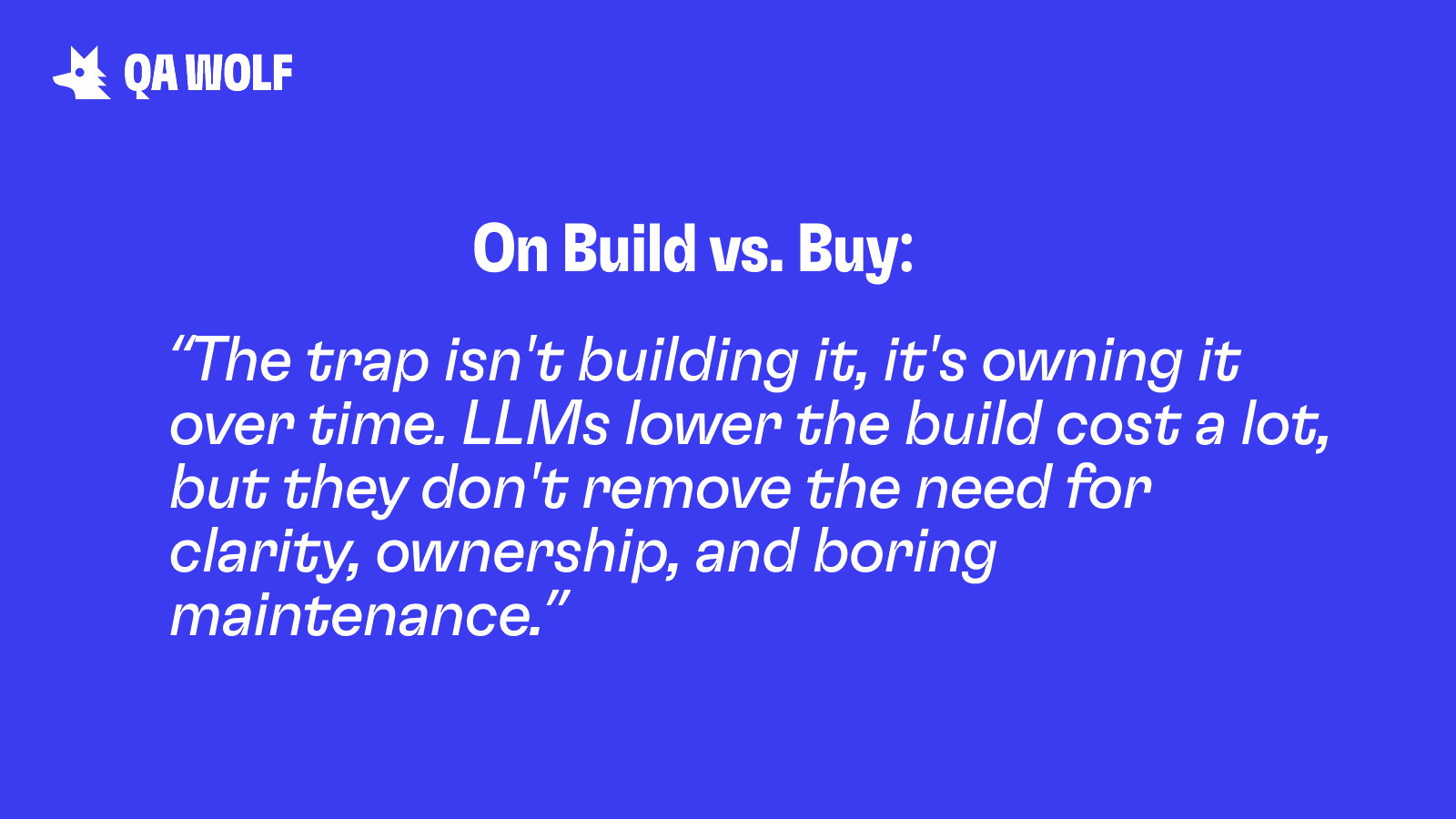
- “I think the trap isn't building it, it's owning it over time. The POC always looks great. a year later its auth edge cases, data drift, one dev who knows how it works, and no clear audit trail. llms lower the build cost a lot, but they don't remove the need for clarity, ownership, and boring maintenance. for stable, narrow tools build makes sense, but only if you treat it like a real system, not a clever script.”
- “How will ongoing updates, bugs be logged and built? Do your developers have time? Is it secure? Maintainable? Extensible? Portable to new OS or technology if needed in 10 years? … Remember that manpower is not free, and it’s easy to underestimate “6 hours per year” is probably not true overall.”
- “There's a reason even companies with large developer pools don't re-invent the wheel and build all their own systems. The moment you do, it's an albatross around your neck. You have no support, no one to blame, no one to negotiate with, etc. You have to ensure the security, operations, maintenance, and future enhancements.”
Those words of caution align with what sales teams at dev tool companies tell us they’re increasingly seeing and what our sales team also is increasingly seeing. A prospect or customer informs them that, actually, their company has decided to just build the tool rather than buy it. They thank them for their time and go about their way, expecting they’ve found the solution that won’t just solve their problem but will also save their company lots of money.
A few months later, maybe they even write an engineering blog or social post about how they built that tool. People comment. They’re inspired to build their own tools, too. The initiative, outwardly, seems like a big success.
Until… a few months after that, they reach back out to that salesperson to share that, in reality, the process was a waste of time and money and they’re ready to buy the tool they were talking about purchasing months previously.
The problem is that internal tools are often launched loudly and deprecated quietly. So, others internalize that building is an option… and not that it is an option that is likely to fail.
What's fueling the new desire to build over buy?
The desire to build over buy is fueled by some of the best things about developers — their willingness to jump in, their bias toward shipping, their genuine enthusiasm for figuring out what new technology can do.
But the traits that make developers great at building things like their optimism and the belief that any problem is solvable with enough effort — are also the traits that make it easy to underestimate what ownership actually costs. The decision to build feels like the ambitious one. Buying feels like admitting you couldn't do it yourself.
But the engineers who've been around long enough know that buying the right tool and redirecting that energy toward the problems only your team can solve isn't a concession. It's the smarter play.
Here are some things that influence teams’ decisions:
The AI confidence effect
We've all been there. You sit down with a problem, start prompting, and an hour later you have something that actually works. It connects to the right data, the UI looks clean, and the demo lands well in the standup.
And then comes the thought that gets teams into trouble: “The hard part is done.” But what's actually left is everything that makes software production-ready. Edge cases. Error states. Security. Performance under real load.
The proof of concept has never been easier to reach. Everything after it is exactly as hard as it always was.
The customization illusion
This has always been a factor in build vs. buy decisions but AI supercharged it. If building is fast and cheap, why settle for a tool that's 80% right when you can build something that's exactly right?
The problem is that most internal tool requirements aren't as unique as the teams building them believe. The customization that felt essential at the start rarely justifies the overhead it creates. And the 20% gap that drove the build decision has a way of looking a lot smaller once you're six months into maintenance.
The cost illusion
When teams decide to build, they calculate the sprint cost. That's the number that goes into the conversation: a few engineering days, maybe a week, a Claude subscription that the team is already paying for anyway.
What doesn't go into that number: the ongoing maintenance hours or the debugging sessions when an integration changes upstream. A Claude subscription and a few free afternoons isn't the cost of building an internal tool. It's the cost of starting one.
The "Just a wrapper" fallacy for AI tools
There's an incorrect assumption embedded in a lot of build decisions: that the AI tools teams are considering buying are basically just an LLM API call with a nice UI on top. But that is almost never true.
The tools teams are dismissing as overpriced were built by entire teams of engineers, ML specialists, and domain experts who spent months building evaluation frameworks, iterating on the prompts that make the tool actually useful, building complex ML pipelines and prompts to reduce inference latency, and scaffolding features and integrations on top of that.
When a developer with a Claude subscription decides to build instead of buy an AI tool, they're signing up to replicate that entire body of work — without the team, the expertise, or the runway to do it properly. The vendor isn't charging for an API call. They're charging for the complex engineering behind the actual tool that you can’t directly see.
The real cost of building vs buying AI dev tools
The build decision rarely feels like a gamble in the moment. It feels like the obvious call — faster, cheaper, more tailored to exactly what the team needs. And with AI making the initial build so frictionless, the case for buying has never been harder to make.
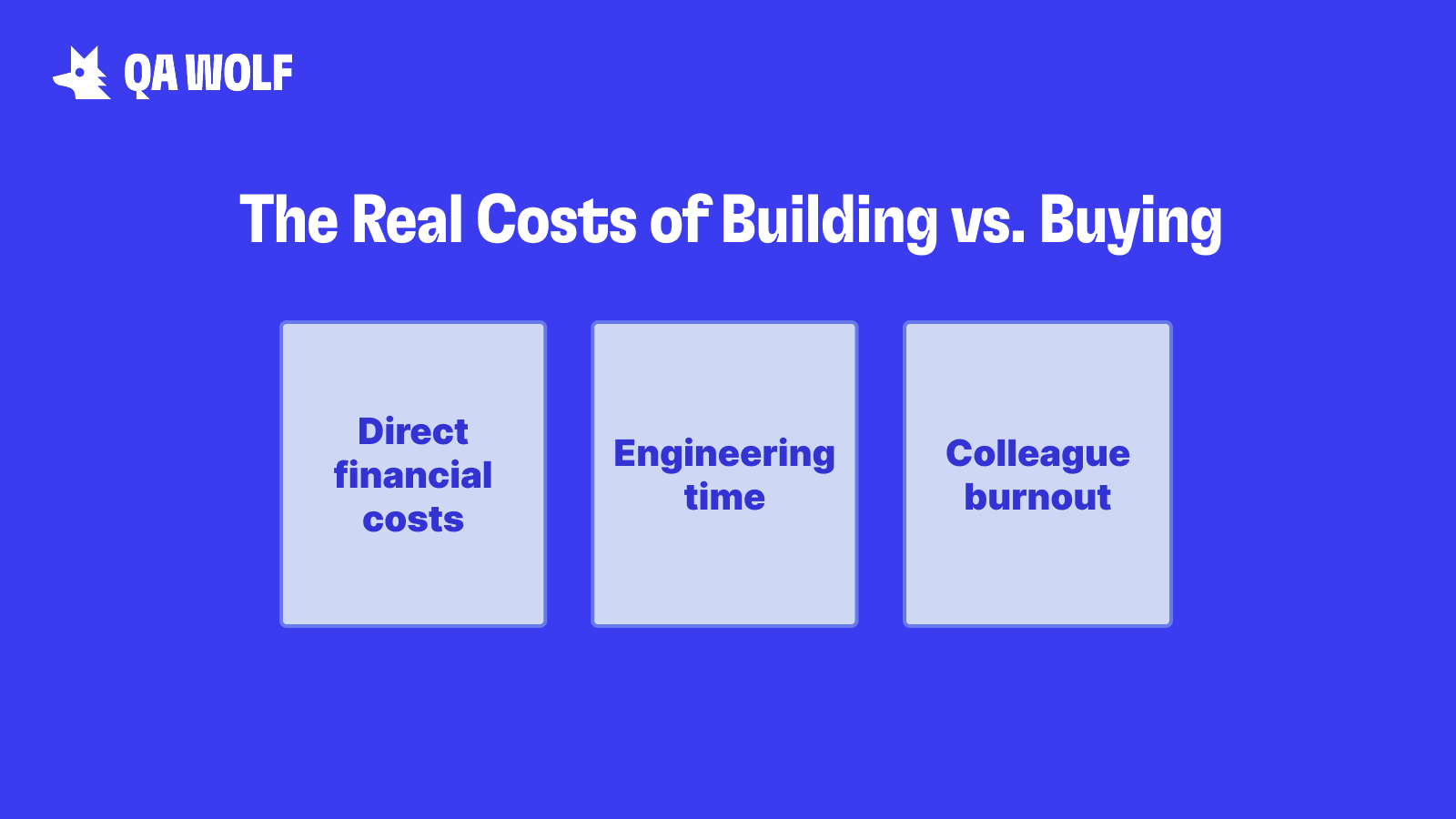
But the real costs of building are often more expensive than buying. Here’s some things to consider:
Time costs
The estimate is always wrong. Here's what gets left out.
- The build itself runs over. Integrations take longer than expected. Edge cases surface late. Add 30% before you've shipped anything.
- Every bug is an unplanned debugging session. It pulls someone off whatever they were actually supposed to be working on. That time gets absorbed silently.
- Every upstream change breaks something. APIs need to be updated. Dependencies get deprecated. Each one is an unscheduled afternoon, sometimes more.
- Opportunity costs. Every hour spent maintaining a built tool is an hour not spent on the work only your team can do. Sprints go to keeping an internal tool alive or updating it.
- Maintenance never stops. It just arrives disguised as Slack messages, quick questions, debugging, and incidents.
Add it up honestly and most teams have spent three to five times the original estimate just keeping the tool alive — before counting what didn't get built while they were doing it.
Inefficiency costs
The time cost is only part of it. There's a slower, quieter cost that compounds underneath it.
- The tool falls behind immediately. The vendor you didn't buy ships new features every quarter. Your internal tool ships whatever someone has time for, which is usually nothing. The gap between what your tool does and what the market offers was present at launch but continues to widen from there.
- Nobody documents it properly. Which means every new user figures it out themselves. Which means slower adoption, more questions, more senior engineer time spent explaining a tool that a bought solution would have shipped with a knowledge base, onboarding flow, and support team.
- The tool works. It just doesn't work well. The UI is functional but unintuitive. Latency is higher than it should be. Features that would save people ten minutes a day were never prioritized. The export that would happen automatically with a bought tool gets done manually. The integration that was never built gets substituted with a copy-paste habit. Every hour spent navigating its limitations is a time tax that a bought tool would have engineered away.
- Then, people stop using it. Not all at once — gradually. Someone finds a better option. Then another person does. Adoption quietly erodes until the tool is effectively abandoned.
At that point the original build cost, the maintenance hours, the debugging sessions, and every sprint that got pulled into keeping it alive — all of it was spent building something nobody uses. That's the final cost. And it's the one that never makes it into the post-mortem, because there usually isn't one.
AI tool complexity
If the internal tool is an AI-powered tool, that leads to additional issues. Many AI tool companies have declared the era of simply swapping in the latest frontier models to update your tool is over. Models have diverged in fundamental ways. A prompt that performs well on one model may degrade on another. Staying current requires building internal evaluation frameworks that track not just accuracy but the metrics that matter for your use case.
Most internal teams have no one equipped to do this and no plan for when it needs to happen. When a new model drops, they have two options: do the eval and prompt work properly, or ignore it and fall further behind. Most choose the latter and the quality of the AI tool continues to degrade relative to what else is on the market.
10 questions to ask your team before building vs. buying
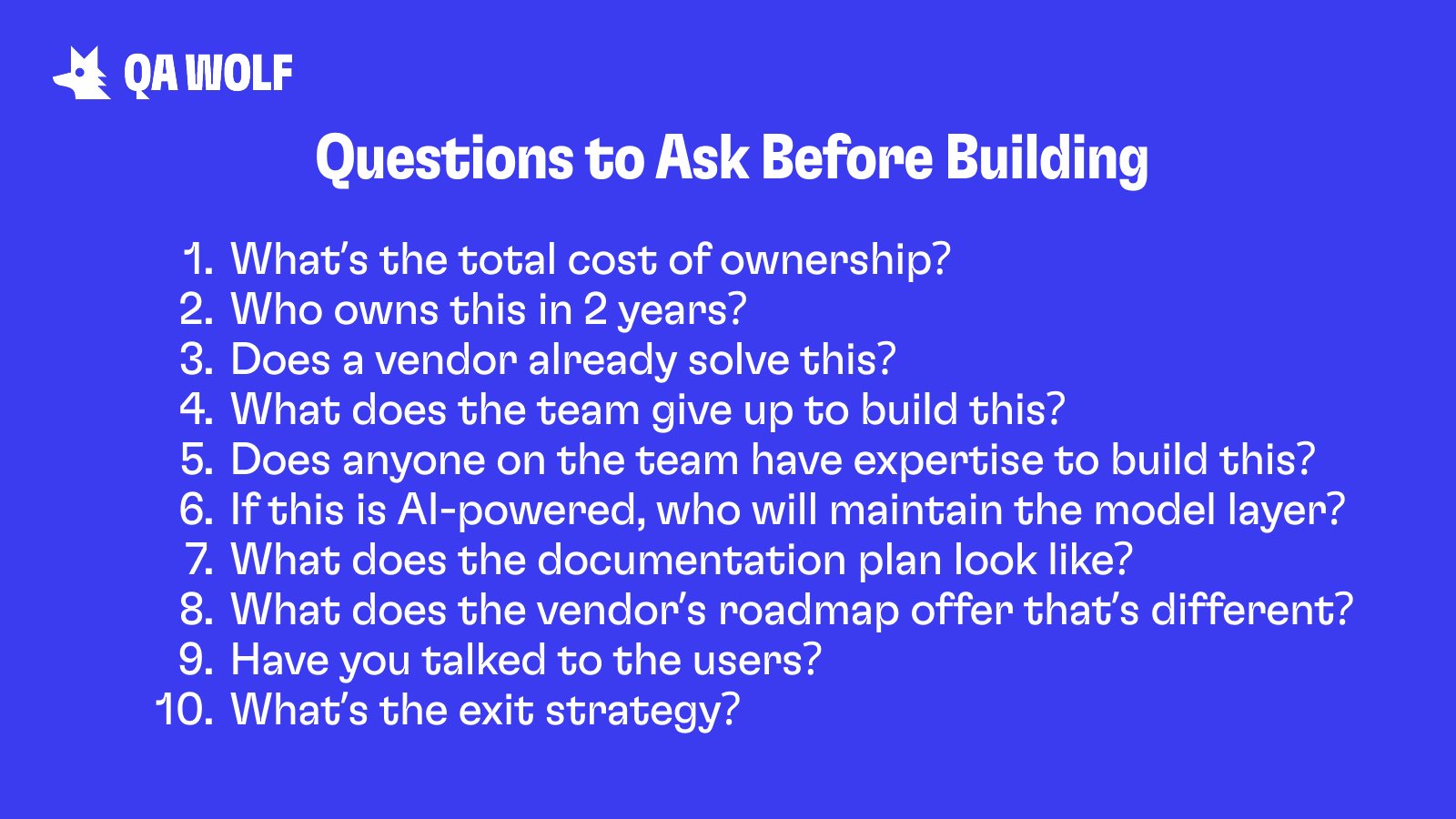
Before the build decision gets made, slow down and work through these first.
1. What is the total cost of ownership, not just the build cost? Account for maintenance, debugging, integration updates, and the ongoing engineer hours required to keep it alive.
2. Who owns this in two years? Not who's building it — who owns it. If the answer is unclear, or if it's the same person building it and they might not be on the team in two years, that's a problem worth solving before you start.
3. Does a vendor already solve this well enough? Not perfectly. Well enough. If a bought tool covers 80% of the requirement, is the remaining 20% worth the full lifecycle cost of building and maintaining something custom?
4. What does the team give up to build this? Every sprint spent on an internal tool is a sprint not spent on something else. What's getting deprioritized and is the tradeoff worth it?
5. Does anyone on the team have the expertise to build this properly? Not just to build a working prototype but to build something production-ready, secure, and maintainable. If the honest answer is no, that’s your answer.
6. If this is an AI-powered tool, who will maintain the model layer? Models change. Prompts that work today may not work on the next frontier release. Is there someone on the team equipped to run evals, re-engineer prompts, and keep the AI layer reliable over time?
7. What does the documentation plan look like? If there isn't one, the knowledge lives in one person's head. What happens when they leave?
8. What does the vendor's roadmap offer that you won't build? Bought tools ship new features continuously. Your internal tool ships whatever someone has bandwidth for. How long before the gap between the two becomes a problem?
9. Have you talked to the people who will actually use this? Not the people who requested it — the people whose daily workflow depends on it working well. Their definition of "good enough" is the one that matters.
10. What's the exit strategy if this doesn't work out? If the tool fails or gets abandoned, what does migration look like? If there's no answer to that question, the decision is being made without accounting for the most likely outcome.
Knowing when not to build is a superpower
Nobody builds an internal tool believing it will fail. The engineers who pushed to build, who stayed late to get the prototype working, who genuinely believed this was the right call for the team: they were acting in good faith. They were working with incomplete information, optimistic timelines, and a set of AI tools that feel like magic sometimes, even though we know they’re not. That's a very human response to a decision that the whole industry is still figuring out.
If your team is standing at that crossroads right now, you deserve a decision-making framework that accounts for what building actually costs and doesn’t underestimate the complexity of the tool you’re hoping to build. Most of the time, the answer to buy vs. build remains the same even with AI coding agents at our fingertips: Buy the tool. Point the builders at something your company is best at.
Interested in buying rather than building a QA platform? Claude can only do so much. We help you manage 13x more tests and run them 12x faster. Sign up today!