Key takeaways
Define "self-healing" before you buy.
Self-modifying tools change tests to pass without understanding why they failed. True self-healing diagnoses the failure and applies a targeted fix that keeps the test’s original purpose intact.
Selector swapping is not self-healing.
Tools that "heal" by repeatedly updating selectors can miss real regressions (selectors only account for 28% of failures). Modifying tests solely to make them pass risks validating the wrong behavior and allowing bugs to reach production.
Test data management determines whether AI keeps context or loses it.
AI systems have finite memory. Tools that rely on pruning or selective filtering can discard meaningful context. Approaches based on summarization and targeted retrieval preserve recent history and allow deeper inspection when needed, reducing the risk of subtle regressions slipping through.
Portable, readable code is non-negotiable.
If an AI testing tool hides Playwright/ Cypress behind a proprietary abstraction layer, you risk vendor lock-in and unreadable exports. Prioritize tools that generate clean, maintainable code using standard frameworks and established patterns like AAA (Arrange-Act-Assert).
AI testing tools promise faster test creation and self-healing capabilities, but most fail to deliver on these promises. Before adopting an AI testing solution, you need to understand three critical distinctions: whether it truly self-heals or just self-modifies, how it manages test data without losing context, and whether it generates portable code you can actually use.
Regression testing is repetitive, which is why automating it makes sense. Robots are great at repetitive tasks. But running automated tests is a tiny fraction of what goes into QA automation.
The real work happens after each test run: investigating failures, manually reproducing bugs, re-running flaky tests, and fixing tests when releases change expected behavior.
That ongoing maintenance burden is why 2/3 of companies test less than 50% of their user workflows. Maintaining broad coverage requires one test automation engineer for every four front-end developers. That's why AI-powered testing tools that promise "natural language" test creation and "self-healing" are so appealing: faster, cheaper test creation and maintenance means you could build a more extensive test suite and test more often.
Many AI testing tools rely on off-the-shelf language models like OpenAI or Anthropic, and how those models are implemented determines whether teams can increase test coverage, expedite QA cycles, and make humans more effective.
I'd say the various no-code AI tools were very easy to set up but very difficult to scale. It always felt like the no-code AI tools just made things more complicated and unpredictable in more unpredictable ways. The premise is interesting but they slowed you down about as much as they sped you up.
— Philip Seifi, Co-founder at Colabra
Question 1: Is the AI testing tool actually “self-healing” or just self-modifying?
There are scads of AI testing tools out there that claim to “self-heal” and “auto-heal.” That sounds pretty cool, and it can actually be helpful if implemented properly.
Most tools are self-modifying rather than truly self-healing. They automatically change failing tests to make them pass, without proving the change preserves what the test was originally meant to validate. True self-healing starts by diagnosing why the test failed, then applying a targeted fix that preserves test intent.
What is self-healing in test automation?
Self-healing in test automation is an approach where a system detects a failure, diagnoses the root cause, and applies a category-specific remediation without manual intervention.
Many tools that describe themselves as “self-healing” are built primarily to handle broken selectors, which only account for 28% of test failures. A selector is an element property that automated tests use to identify something on the page—a button, a link, or a block of text. Selectors change frequently as developers tweak the UI or underlying code, causing test failures that have to be resolved.
Updating a selector is fairly trivial for a human, what with their judgment, intuition, and other human niceties. But selector-only self-healing AI has none of that, so it falls back on basic decision-making: "Only a true bug could stop a test from passing. So if the test can pass, then ipso facto, there can't be a bug."
To an AI limited to selector healing, the logic is sound. All it needs to do is modify the test until it passes again. The problem is that more than 70% of failures have nothing to do with selectors, and changing the test without understanding why it failed is how teams end up with false passes and broken trust in their automation.
Why self-modifying isn’t enough
Let's look at examples that show why this distinction is critical.
Example 1: Dynamic selector changes
Your app has a built-in messaging system. The inbox button shows an updating unread count, like “Inbox (3).” When the AI writes a test to open the inbox, it uses "Inbox (3)" as a selector and doesn't know that the message count can change.
On the next run, the UI shows "Inbox (7)," which breaks the test, so the AI replaces the selector with "Inbox (7)," and the test passes.
This approach works, albeit inefficiently. The AI can repeat this change on every run without improving the stability of the test. More importantly, modifying a test only to make it pass can change what the test is actually validating and allow real product issues to go unnoticed.
Example 2: The typo problem
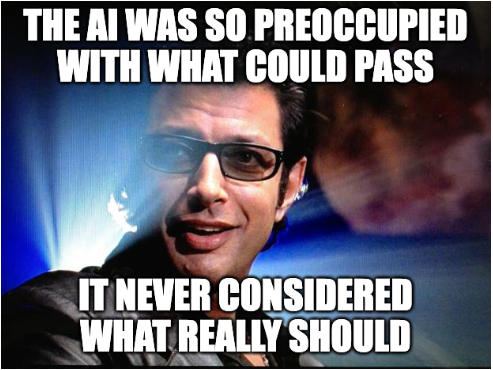
A developer accidentally changes the "log in" button text to "logggin." The test fails because it can't find the old (correct) selector. A selector-only healer updated the locator to match "logggin," and the test passes.
Now, the locator is valid, and the test resumes and passes. And if you are practicing continuous delivery, you have a glaring typo on your production site.
The worst part isn't the embarrassment of the typo—it's that your developers no longer trust the AI to accurately test their releases, so they go back to manually testing each PR.
What true self-healing requires
For AI to genuinely "self-heal," it needs more than just the ability to change a failing test to a passing one—it must first determine why the failure occurred and whether a proposed change preserves the original intent of the test.
That process starts with diagnosis. Before any change is applied, a self-healing system needs to identify the type of failure. Failures commonly stem from selector changes, timing or async ordering issues, runtime or environment crashes, invalid or expired test data, visual assertion mismatches, or interaction changes that alter element visibility through menus, tabs, or panels.
Once the cause is understood, the response must match the failure. The goal is not to “make the test pass.” The goal is to preserve what the test was meant to validate while eliminating non-bug noise.
Just as important, teams need visibility into what was healed and why. Without diagnosis and a clear audit trail, self-healing devolves into silent test rewriting. Silent rewrites undermine trust in automation and make failures harder—not easier—to reason about over time.
Question 2: How does the AI testing tool manage test data and history?
AI testing tools differ in how they retain test data and historical context. Every AI system has a maximum amount of information and history it can use in its decision-making, along with techniques for handling that data.
Pruning or selective filtering
Some AI testing tools use pruning, or selective filtering, where the AI strategically ignores certain details to streamline decision-making, potentially leading it to miss important context.
Imagine an e-commerce checkout process where a "Shipping Method" dropdown typically defaults to standard shipping. A recent update changes the default to express shipping, which incurs an additional fee. The AI sees the dropdown as a functional element with multiple valid options and doesn't register this change as significant. The test passes because all options are technically functional, but a human would catch the unintended cost impact on users who don't actively choose a shipping method.
Summarization and targeted retrieval
Summarization and targeted retrieval take a different approach. Instead of discarding information, the system retains recent history—often spanning a set period, such as two weeks—and generates summaries of relevant changes to reduce noise. The AI reasons over these summaries to identify key trends and behaviors without combing through extensive logs.
When deeper insights are required, the system allows targeted queries into specific events within the stored timeframe, ensuring all relevant context is available on demand.
This approach preserves critical information across multiple test cycles. For example, if a button's behavior changes unexpectedly, the system can surface a summary of recent UI changes to help identify relevant updates quickly. Rather than pruning data to fit into fixed token limits, the AI preserves important information for later review.
QA Wolf’s AI testing platform uses this approach to balance efficiency and depth, reducing the risk of missing subtle yet meaningful changes and providing a predictable way to access context when investigation is required.
Question 3: Does the AI testing tool generate portable, readable code?
AI testing tools should generate portable, readable test code using standard frameworks like Playwright or Appium. Teams should be able to inspect, debug, and modify that code directly, using familiar patterns such as AAA (Arrange–Act–Assert), without relying on proprietary tooling or hidden context.
Over time, your team will need to debug AI-generated tests (crazy, we know!) and adapt them as product requirements change. If the generated code is difficult to understand or tightly coupled to a specific system, both tasks become slower and more expensive.
Portability
Many generative AI testing tools work by wrapping vanilla tools (e.g., Playwright, Appium, or Cypress) in an assistive abstraction layer (i.e., a UI) that hides the underlying code and prevents direct modification. Even when tools allow code export, the result is often difficult to run or understand out of the box. Shared logic is frequently duplicated across individual tests, leaving your team responsible for refactoring to meet basic maintainability standards like DRY (Don’t Repeat Yourself).
Readable test code
Readable code determines whether AI-generated tests remain usable over time. Many systems generate JavaScript optimized for the tool’s own needs rather than for human readability. The result is often complex, inefficient code that is hard to inspect, debug, or modify.
In some cases, tests even depend on hidden internal services or proprietary helpers. This limits who can safely work with the code and makes future changes harder. If your team later switches testing frameworks, large portions of the test suite may be unusable, forcing a partial or full rebuild.
When evaluating AI testing tools, look for tools that intentionally generate test code meant to be read, understood, and modified by humans.
Self-healing requires diagnosis, not blind automation
The most expensive part of automated testing is not writing tests, but investigating failures and maintaining them as products change. AI can take on that work, but only if it understands more than how to make a test pass.
Tools that “self-heal” by silently modifying tests without diagnosing the failure create false confidence and erode trust. Real self-healing preserves test intent. It identifies root causes, manages test data without losing context, and applies targeted fixes instead of generic patches.
QA Wolf’s Agentic Automated Testing platform is built around that model. Agents generate and maintain human-readable Playwright or Appium code, diagnose failures across all major failure categories, and apply fixes with full visibility into what changed and why. This diagnosis-first approach allows QA Wolf to self-heal effectively across the full spectrum of real-world test failures, not just broken selectors.
AI already improves test coverage and reduces maintenance cost when it is applied with discipline. The difference between tools that help and tools that hurt comes down to implementation details: diagnosis before remediation, transparency instead of silent changes, and code your team owns.
Frequently asked questions
How do AI testing tools work?
Most AI testing tools use a large language model—often from OpenAI or Anthropic—to translate a human description of a workflow into executable steps, then run those steps in a browser automation framework like Playwright, Appium or Cypress. The real difference between tools shows up after tests run: stronger systems diagnose failures, retain enough historical context to reason consistently, and generate readable code teams can maintain outside the vendor’s UI.
How do AI testing tools automatically generate tests from plain English?
AI testing tools interpret a natural-language scenario (for example, "log in, add an item to cart, and check out") and convert it into automation code and assertions in a framework like Playwright, Appium or Cypress. Quality varies by implementation: the best tools generate deterministic, structured tests that follow standard patterns (like Arrange-Act-Assert), while weaker tools produce opaque or tool-specific scripts that are hard to review, debug, or reuse.
What is self-healing test automation, and how is it different from "self-modifying" tests?
Self-healing test automation diagnoses why a test failed and applies a targeted fix that preserves test intent. Effective self-healing works across six failure categories—selectors, timing, runtime errors, test data, visual assertions, and interaction changes—rather than assuming every failure is a broken locator.
Self-modifying tools skip diagnosis and simply change tests until they pass, often by swapping selectors, which account for only 28% of failures. This can hide real issues when failures stem from timing, data, runtime, or interaction problems, leading to false passes.
What should I check before trusting an AI tool to "auto-fix" failing tests?
Confirm the tool doesn't blindly modify tests just to make them pass. Look for (1) an intent-preserving self-healing approach with human review gates for risky changes, (2) transparent reporting of what changed and why, (3) strong context handling (summarization plus targeted retrieval rather than pruning), and (4) code output you can inspect and run locally in a standard framework like Playwright or Appium.